Sikkim was an independent kingdom ruled by the Chogyals (Kings) until
1975 when it became the 22nd state of the Indian Union.The Chogyals ruled
Sikkim for 300 years and the history of Sikkim's Chogyals dates back to
the 17th century, when three holy men at Yuksam in West Sikkim, consecrated
the first Chogyal.
Over this period due to account of their deeds and actions they wrote
their names in history of Sikkim. Until Sikkim became a part of India
as the 22nd state, the Choygals were both the law and religion. Palden
Thondup Namgyal was the last monarch of Sikkim.
1. 1642 A.D. - Chogyal Phunstok Namgyal
Ascended the throne and was consecrated the first Chogyal of Sikkim,the
capital was Yuksam.
2. 1670 A.D. - Tensung Namgyal
Shifted capital to Rabdanste from Yuksam
3. 1700 A.D. - Chakdor Namgyal
Pendiongmu (Half sister) tried to dethrone Chakdor , who had
to flee to Lhasa, but was reinstated as king with the help of Tibetans.
4. 1717 A.D. - Gurmed Namgyal
Sikkim was attacked by Nepalese.
5. 1733 A.D. - Phunstok Namgyal
Nepalese attacked Rabdanste-the capital of Sikkim.
6. 1780 A.D. - Tenzing Namgyal
Chogyal fleed to Tibet and died there.
7. 1793 A.D. - Tsudphud Namgyal
Capital shifted from Rabanste to Tumlong. Treaty of Titalia in 1817 between
Sikkim and British India was signed in which territories lost to Nepal
were restored to Sikkim. Darjeeling was gifted to British India in 1835.
Two Britishers Dr. Campbell and Dr. Hooker captured by the Sikkimese in
1849. Hostilities between British India and Sikkim and a treaty was signed
in which Darjeeling was annexed to British India.
8. 1863 A.D. - Sidekong Namgyal
9. 1874 A.D. - Thutob Namgyal
Claude White appointed, as the first Political of Sikkim in 1889. Capital
shifted from Tumlong to Gangtok in 1894.
10. 1914 A.D. - Sidekong Namgyal
11. 1914 A.D. - Tashi Namgyal
Treaty between India and Sikkim was signed in 1950.
12. 1963 A.D. - Palden Thondup Namgyal
Sikkim became 22nd state of India on 16th May, 1975. Institution of the
Chogyals came to an end.
Sikkim is situated between Nepal and Bhutan. From a low of 800 ft. above
sea level to the Summit of Mt. Kanchendzonga (28,169 ft.), the guardian
deity of Sikkim and the third tallest peak in the world. Mountains criss-cross
the country that is rich in flora and fauna, stunning mountains, beautiful
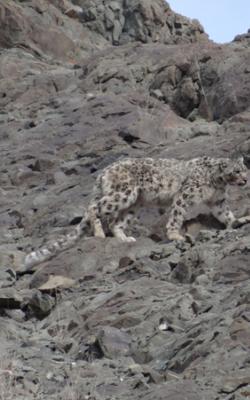
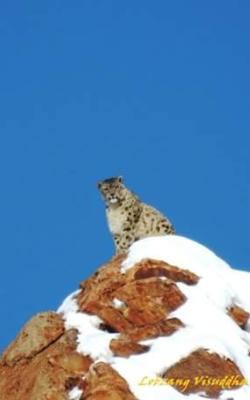
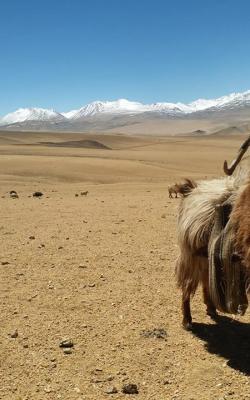
valleys, clear lakes and lush evergreen forests. In high altitudes where
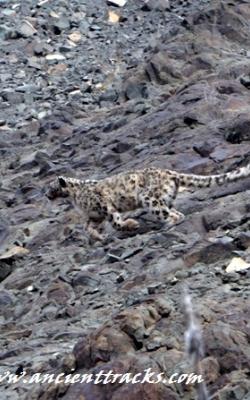
yaks graze are found the snow leopard, the blue sheep, goral, tahr and
the red panda the state animal of Sikkim. Some 600 to 1000 species of
orchids alongwith a variety of plants and flowers create visual delight,
all of which the Goverment of Sikkim helps to protect by creating a national
park, two wildlife sanctuaries, an alpine sanctuary and a rhododendron
sanctuary.
Sikkim, tucked away in India's North-East corner, between Tibet, Bhutan
and Nepal is, without question, a very special part of India beautiful,
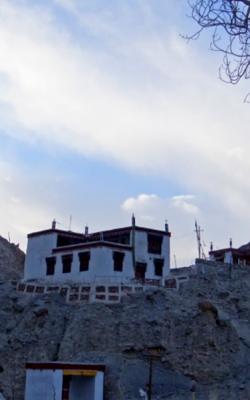
unspoilt, green, full of orchids, mountains, butterflies and monasteries.
SIKKIM, a small Himalayan State which is the second smallest state of
India, lying between 27 to 28 degrees North latitude and 88 to 89 degrees
East longitude is the second smallest state in India. It is barely 7,096
sq. kms in size yet has an elevation ranging from 300 mtrs. to 8585 mtrs.
above sea level. It's Geography is dominated by the most majestic mountain
chain in the world which includes the Khangchendzonga, world's third highest
mountain and is worshipped by the Sikkimese as the guardian deity to their
land.
AREA : Sikkim is situated 7096 sq. kms. in the Eastern Himalayas, bordering
the Tibet autonomous region to it's North, Tibet and Western Bhutan to
it's East, Eastern Nepal to it's West and the Darjeeling Gorkha Hills
of West Bengal to it's South.
CAPITAL TOWN : Gangtok is elevated at 5,840 feet above sea level.
DISTRICT HEADQUARTERS : North - Mangan, South - Namchi, East - Gangtok,
West - Gyalshing.
POPULATION - 5,40,493( Census -2001)
LANGUAGE SPOKEN : Nepali, English, Hindi, Bhutia (Sikkimese), Bhutia
(Tibetan), Lepcha, Limboo.
LITERACY RATES : 69.68%
CLIMATE Cold Winters in the month of November to February with minimum
temperatures dipping to 4 centigrade during January - February. It is
between the month of March and early May when sunshine is quite abundant.
Though summer is officially from May to October, Sikkim is almost always
wet due to the heavy monsoons, with rains at times continuing for days
on ends. Longest recorded nonstop rain is 11 days. September to October
is Autumn. A peculiar feature of Sikkim weather is that though there is
a classification of sorts of the various seasons, actually experiences
a cold winter from end of November to February and monsoons throughout
the year with a little respite during May - June and October - November.
Even the winter months can be irritatingly wet and damp with the unpredictable
showers.
Until 1975, Sikkim remained an independent kingdom, ruled by the Chogyal,
whose palace is tantalizingly hidden by trees, and is inaccessible to
the public. The Tsuk-La-Khang, or Royal Chapel, is not always open to
the public - it's better to go and ask, for depending on the guard on
duty, you may be able to gain admission.
Gangtok means, aptly enough "hill top" and the little capital
of Sikkim is perched at 5,500 feet, high on the ridge of a valley. From
Gangtok, you look over the hillside, down and across to terraced fields,
with tall, white Buddhist prayer flags flutteri ng in the wind, and endless
vistas of many shades of green. The town careers wildly and very steeply
up and down the hillside, and no matter how you arrange it, you'll always
end up at the top of the hill when you want to visit the little restaurant
at t he foot of the hill, or you'll be at the bottom of the town, and
remember you have to do some shopping at Cottage Industries, right at
the top-just resign yourself to lots of steep climbs, and being a lot
trimmer at the end of your stay.
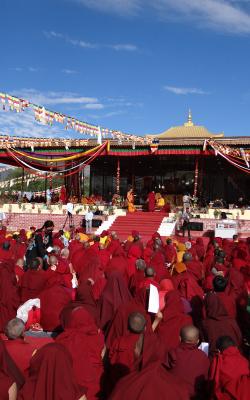
In Sikkim various communities with their own customs, religion and culture
intermingle freely to constitute a homogeneous blend. The predominant
communities are the LEPCHAS, BHUTIAS and NEPALESE. Many plainsmen have
also settled, especially in the urban areas and they are almost always
engaged in business and Government service. A small part of the population
consists of migrant labourers from the plains and Nepal attracted by the
development activities in the state, like the construction of roads, bridges
and buildings.
|
 |