Hemis
Festival
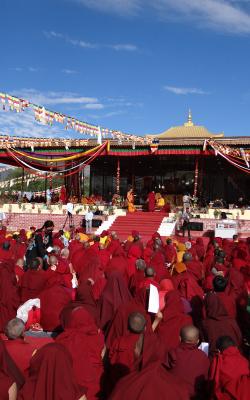
Hemis festival is one of the most famous monastic festivals in June to commemorate
birth of Guru Padmasambhava, the founder of Tantric Buddhism in Tibet. The
sacred dance drama of the life and mission is performed wearing facial masks
and colorful brocades robes. The three-day festival takes place from 9th
to 11th. Especially the monkey year festival, which comes in a cycle of
12 years. During it the four-storey thanka of Guru Padma Sambhava is hung
in the courtyard and other precious thankas are also exhibited.
Thiksey,
Karsha and Spituk Gustor
Gustors take place at Thiksey, Spituk and Karsha in different months of
the year. The festival takes place for two days. The celebration is to mark
the victory over evils. The mask worn by the dancers represent the Guardians,
Protectors and the Gods and Goddesses. The festival ends with the symbolic
assassination of evils and burning of the effigy of evils.
Dosmochey
Dosmochey is celebrated in Leh (Leh Palace), Liker (Lower Ladakh) and Deskit
(Nubra valley) monasteries in February. The most famous among all is Leh
Dosmochey, which is celebrated for two days in the courtyards of the Leh
palace. The monks from different monasteries perform the Chams every year
turn by turn. The festival takes place in the end and starting of the Tibetan
New Year. The monks of Takthok monastery prepares the offering with Thread
crosses which binds all the evil, hungry ghosts and guard against natural
disaster in the coming year. On the second day of the festival, the offerings
are taken out of the town in a procession and burn it while people whistle
to chase away the evil spirits.
Matho
Nagrang
Matho Nagrang is celebrated on the 15th day of the 1st month of Tibetan
calander, at Matho monastery, the only monastery of the Sakya School of
Tibetan Buddhism. During these two days of festival mask dances are performed
by monks of the monastery wearing colorful silk brocaded robes and mask
in different forms of God and Goddesses. The festival is famous because
of appearance of the two oracles during the festival after full month meditation
in complete isolation. The two oracles appear in the courtyard accompanying
mask dancers and predict future events and people from far and away come
to seek advice to perform ritual to tackle with disasters.
Stok
Guru Tsechu
The monks of Stok and Spituk monasteries also celebrate Stok Gruru Tsechu
for two days with mask dances performed. It is also held in Feb. around
a week before the Matho Nagrang. During the festival two oracle appears,
but they are laymen from the same village prepared by monks to receive the
spirit of the deities.
Phyang
Tsedup
Phyang Tsedup takes place in July / August. Like other monasteries, monks
wearing colorful brocade robes and Mask in the form of different god and
goddesses perform mask dances. The huge thanka of Skyoba Giksten Gonbo is
hung in the courtyard during the festival.
Yuru
Kabgyat
The 2-day festival takes place in July in Lamayuru monastery around 125
kms. from Leh. Monks like other monastic festival perform mask dances. During
the festival monks perform prayer and rituals to get rid of disaster and
peace in the world.
Losar
Celebration
The Losar (New Year) celebration is followed by Galdan Namchot, the birth
anniversary of Tsogkha pa who introduced Gelukpa School of order. During
Namchot people illuminate their houses, monasteries and mountains and make
offerings in the houses and monasteries.
The Losar festival is celebrated in the eleventh month of Tibetan calendar,
two months ahead of Tibetan New Year. In early 17th century, King Jamyang
Namgyal decided to lead an expedition against the Baltistan forces in winter;
therefore he decided to celebrate the festival two months before. Later
it became a tradition and being celebrated in the eleventh month.
The festival lasts for around a month, during which Gods, deities, ancestors
and even the animals are fed without fail. Images of Ibex are made as auspicious
symbol, walls of the kitchens are dotted and are believed to bring prosperity
in coming year. The Metho (procession of fire) is thrown out chanting slogans
and chasing hungry ghosts and evil spirits, and they return with rocks of
ice as auspicious symbol and these are kept in the store. In some villages
there is a tradition of making Old men and women, from this snow which last
for a week. Over all the Losar all children and young and olds enjoy and
celebrate the festival. All family members get together to celebrate if
someone missing will have their cups filled with tea by their name.
Ladakh
Festival
Ladakh festival takes place in September 1-15 every year in Leh and villages.
The inauguration ceremony takes place in Leh on large scale with the procession
of various cultural troupes from different part of Ladakh. It passes through
Leh Market dancing, singing with traditional music, in colorful traditional
Ladakhi dresses, and finishes at Polo ground after performing their best
dances and songs. The festival last for 15 days with regular program in
different villages. The program includes Archery, Polo, and Mask Dances
from the monasteries, traditional dances by cultural troupes from Villages.
Sindhu
Darshan (Visit Indus) Festival
Sindhu Darshan is three-day festival held from 1st to 3rd June, in Shey
Manla around 8 kms. from Leh on the bank of Indus river. For the first time
it was organized in October 1997, as a symbol of unity and Communal harmony
and national integration. Whilst promoting domestic tourism in Ladakh. |