INTRODUCTION

Kailash Mansarovar is situated amidst a picturesque landscape in the remote mountains of western Tibet. A journey to this sacred shrine is the experience of a lifetime. One of the highest, loveliest and most desolate places on earth, Kailash Mansarovar has been an ancient pilgrimage for the Hindus, the Buddhists, the Jains and the Tibetan Bonpos. The sublime snow-clad Mt. Kailash, situated at an altitude of 22,028 ft (6,714 m), is revered as a site of immense natural power where the temporal and the eternal unite and divinity takes the physical form. The Mansarovar Lake, on the other hand, is the source of four great rivers: the Indus, the Sutlej, the Brahmaputra and the Karnali.

The Himalayas (abode of snow) are considered the mystical dwelling of the gods from ancient times. Ancient texts, such as the Ramayana, the Mahabharata, the Puranas, and the Vedas, all sing in unison of the glory and wonder of the Himalayas. A large number of mountain peaks and ranges in the Himalayas are named after Lord Shiva, the Lord of Mountains.

The pilgrimage to Kailash and Mansarovar is considered one of the most difficult treks in Asia. The distance is tremendous, the weather is harsh, the supplies are almost non-existent, not to speak of the lurking fear of bandits. In spite of these difficulties and hardships, a magnetic pull draws thousands of pilgrims and tourists to this place every year.

LOCATION

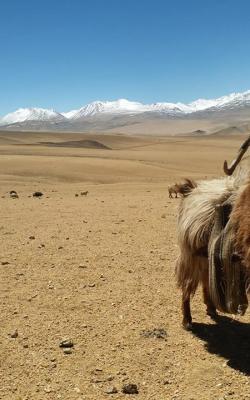
Kailash lies in the Nagri region of Western Tibet. A part of the region is inhabited by few nomadic tribes while the rest is a vast empty plain, devoid of any vegetation. Naked hills of rose, violet and flaming orange scatter off into the distance. The Mansarovar Lake is 15 miles wide and 55 miles in circumference. The turquoise water of the lake is said to possess miraculous healing properties.

BEST TIME TO VISIT

The best time for visiting Kailash Mansarovar is between the middle of May to the middle of October. The weather is generally stable and visibility is at its best during this time. Temperatures are cool during the day and below freezing at night.

HISTORY

Hindus regard Mt. Kailash as the mythical Mt. Meru, the divine center of the universe around which the whole creation revolves. It is described in the ancient texts as a fantastic "World Pillar", its roots in the lowest hell and its top touching the heavens. Sprawling below is the sacred Mansarovar, which is born of the mind of Brahma. A single circuit of Kailash is said to erase the sins of an age, while 108, a holy number, ensures Nirvana.

Buddhists regard Mt Kailash as the Kang Rinpoche, the precious snow mountain. For them, Kailash is a gigantic natural mandala; it is the epicenter of tantrik forces. Buddhists believe that Queen Maya, Buddha's mother, was carried here by the gods and washed before giving birth to Buddha. They undertake arduous journey from Ladakh, Bhutan, Nepal, Mongolia and every corner of Tibet to this place. The Jain religion considers Kailash as Mount Ashtapada. Rishabhdev, the founder of Jainism, attained spiritual liberation atop this summit. To the Bonpos, who are the followers of Tibet's old pre-Buddhist beliefs, it is the 'nine-story Swastika Mountain'-the mystic 'soul' of the entire region.

TOURISTS ATTRACTIONS

The parikrama around Mt. Kailash starts and finishes at Tarchen. From Tarchen, the pilgrim circuit enters the Lha Chhu (God's River) valley, a spectacular canyon below the mountain's western flanks. In the northern face, the trail climbs to the Dolma Pass (18,600 ft.), and then descends quickly into the Lham Chhu Khyer valley before returning to Tarchen. It is 52-km circuit around Mt. Kailash.

The Mansarovar parikrama covers Huore, Chugu and Zaidi, a distance of around 75 km.

PLACES AROUND KAILASH MANSAROVAR PARIKRAMA

Shortly after the Dolma Pass is a large lake called Gouri Kund. A dip in the holy waters of Gouri Kund is believed to vanquish all languor.

Rakshash Tal is just 10 km from Mansarovar. It is at a height of 14,900 ft and is 150 ft deep. The two lakes, Mansarovar and Rakshash Tal, are the highest freshwater bodies in the world connected by a channel called Ganga Chu.

HOW TO REACH

The route from New Delhi consists of both bus journey and high-altitude mountain trekking. The bus route covers the following track:

Delhi-Gajraula-Kathgodam-Nainital-Bhowali-Almora-Kausani-Bageshwar-Chowakari-Didihat-Dharchula via Jauljibi-Tawaghat.

The trekking route which takes the pilgrims through some beautiful terrains and passes, covers the following:

Tawaghat-Thanidar-Pangu-Sosa-Narayan Ashram-Sirkha-Rungling Top-Simkhola-Gala-Jipti-Malpa-Gudhi-Guji-Garbhyang-Kalapani-Avidhag-Lipu Lekh Pass-Pala-Taklakot.

The first halt is at Kasauni near Nainital, which is famous for its sunrise beauty, and the next at Dharchula.

WHERE TO STAY

We offer excellent accommodation facilities in and around Kailash Mansarovar.

Please click here to get more information....

Tourism-of-India.com provides complete information about tourism in Kailash Mansarovar. Tourism-of-India.com offers various tour packages to make your visit comfortable. You can pick the one that suits you most.

Mount Kailash is commonly referred to as the center of the universe in Eastern religious texts from India to Japan. Rooted in the seventh hell and bursting through the highest heaven, it is also believed to be the World Pillar. Hopi Indians recognize Kailash as being at the opposite side of their Black Mesa, thus it’s a cosmic backbone.

Hindus who walk around the 32-mile circumference of Mount Kailash use the term parikrama. They believe that Lord Shiva, one of their three main gods, resides atop what they call Mount Meru. Tibetans refer to the clockwise circumambulation as a kora. Both words mean the same thing: pilgrimage. Doing a walk around the mountain can wipe away a lifetime’s worth of sins, or negative karma as is the term in Eastern religions. “He who performs the Parikrama, the ritual circumambulation of the holy mountain, with a perfectly devoted and concentrated mind goes through a full cycle of life and death” Lama Anagarika Govinda, ‘The Way of the White Clouds.’

The Jains who refer to Kailash as Mount Ashtapada believe the founder of their faith, Rishabanatha, resides atop the mountain. And the Böns [or Bönpos], the religion which predates Buddhism in Tibet, maintain that the entire mystical region and the Nine-Story Swastika Mountain is the seat of all power. When viewed from the south face, a swastika can be seen. Unlike the Jains, Buddhists or Hindus, the Böns make counterclockwise circumambulations. “According to Bönpo accounts, 18 enlightened teachers will appear in this eon and Tönpa Shenrab, the founder of the Bön religion, is the enlightened teacher of this age. He is said to have been born in the mythical land of Olmo Lung Ring, whose location remains something of a mystery. The land is traditionally described as dominated by Mount Yung-drung Gu-tzeg (Edifice of Nine Swastikas), which many identify as Mount Kailash in western Tibet. Due to the sacredness of Olmo Lung Ring and the mountain, both the counter-clockwise swastika and the number nine are of great significance in the Bön religion.” From ‘The Office of Tibet’

Devout Tibetan Buddhists will do full length prostrations, a feat which takes several weeks, around Mount Kailash, increasing the amount of purification they will receive. Many pilgrims do a complete round of the mountain in one day, an accomplishment made more difficult by the 15,000-foot high altitude. Pilgrimages are by their very nature meant to be arduous, and as the Ngari region of Mount Kailash has no airports or train stations nearby, people arrive at their spiritual destination by foot, horseback, yak or jeep. Tarchen is a small settlement near the south face of the mountain; the place where most pilgrimages begin.

Those unwilling or unable to make the kora around the mountain can hire someone who will, thereby splitting the accumulated merit 50/50. This doesn’t allow either the person who sponsors the kora or the one who actually makes the journey to attain instant enlightenment. For those who make the kora, aside from enduring highly changeable weather conditions, there are four prostration points in which to pay physical homage. Many pilgrims make sure they visit the three monasteries located along the path. Near the top of the kora is the Shiwa Tsal, named after the famed cremation grounds in India. Pieces of clothing, a lock of hair or a drop of blood are left there as an offering, signifying the pilgrim’s understanding of death and rebirth. At the highest point of the circuit, just over 18,000 feet, is Dolma La Pass, meaning ‘She Who Helps Cross.’ [The Sanskrit name for the female Buddha is Tara]. This refers to the crossing over to liberation as well as being able to complete the pilgrimage circuit around Kailash. The great boulder of Tara is swathed with long, colorful strings of prayer flags which send out messages of peace with each flap they make in this windy region.

Mount Kailash is also the source of four major rivers: the Indus, the Brahmaputra, the Karnali and the Sutleg. The comparison to the Indian legend of Mount Meru from whose summit flows four great rivers that irrigate all of Asia is hard to miss.

Eighteen miles southeast of Kailash is the circular, turquoise Lake Manasarovar, or Tso Rinpoche, [Precious Lake], a 64-mile circuit, which is rarely completed except by the most devout. Bathing in the lake, or even dousing one’s head with the holy water, is said to be of enormous spiritual benefit to those who can brave the icy water which many claim contain miraculous powers. Hindus are told that complete immersion into the lake ensures they be reborn as a god. Tibetans, on the other hand, avoid bathing in the lake so as not to make it dirty. This is a freshwater lake, three miles above sea level. There is a saltwater lake, separated by a narrow peninsula, named Raksas Tal, or devil’s lake. Pilgrims don’t bathe or circumambulate this crescent moon-shaped body of water, but do pay their respect by glancing in its direction.

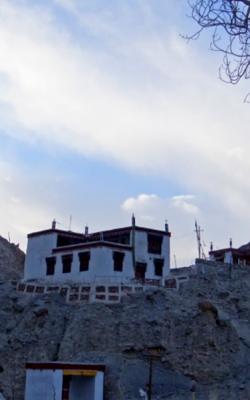
Five monasteries have been rebuilt on the shores of Lake Manasarovar since 1981—before the Chinese invasion in 1959 there were eight. Fatigued pilgrims are allowed to stay in the monasteries. Fewer than 500 Indian nationals are allowed to make the pilgrimage per year due to the Chinese and Indian governments. Most of the Indians allowed in are selected via a lottery and the ability to pay their own way is evident in the fact that the majority of them are middle-aged businessmen from large cities.

Before the Cultural Revolution, pilgrims were selected by their bountiful faith. They traveled on foot or horseback. Some of them made the journey by doing the full-length prostrations along the way, an endeavor which could last for years, depending upon the distance and the weather conditions. Few pilgrims were armed, making them prey to thieves. But even under such extreme conditions, they were unafraid of death; dying during a pilgrimage pretty much guaranteed them a lot of good karma points. Pilgrimages require a degree of flexibility that most people aren’t required to possess in a world with guaranteed insurance benefits and retirement plans. To make a spiritual journey is to rid oneself of habits and to open the heart, making the pilgrim ego less and pure; then allowing this transformation to reach out and positively affect others.

”There is no place more powerful for practice, more blessed, or more marvelous than this; May all pilgrims and practitioners be welcome!" Milarepa, Tibetan Buddhist yogi [circa 1052 – 1136]


  For detail itineraries and bookings please contact
 
©COPYRIGHT 2005. ALL RIGHTS RESERVED. ANCIENT TRACKS.